
Background:
Across the United States, educators and state leaders are working to reverse declining literacy rates by strengthening teacher preparation and professional learning.
New Mexico has taken a proactive approach by requiring educators to complete the Language Essentials for Teachers of Reading and Spelling (LETRS) training, an evidence-based knowledge building program grounded in the science of reading – a body of research drawing on decades of findings across neuroscience, psychology and education to understand how the brain learns to read.
Challenge:
“Structured literacy”—the evidence-based instructional approach aligned with this research—requires explicit, systematic teaching of foundational skills. While LETRs builds essential foundational knowledge, educators often need additional support to translate this knowledge into day-to-day classroom practice.
Word recognition—that foundational ability to decode—has been an essential missing piece for many students across New Mexico, reflecting a broader transition happening statewide as educators move away from older instructional methods.
Students taught with older, non-evidence-based “whole language” or “balanced literacy” methods often struggle to decode unfamiliar words because they weren’t taught systematic letter-sound patterns.

Landry (front left) and her colleagues at the Sunset Hills Elementary School (Alamogordo, NM) discuss reading and literacy best practices in between classes. Photo Credit: Hanna Negusie, Project ECHO, April 2025.
Actions:
Responding to the statewide need for additional support, Project ECHO launched the Structured Literacy Classroom New Mexico ECHO Program in 2023. This year-long program brings K-3 educators together every other week to learn and implement evidence-based structured literacy best practices. Each session combines experts sharing evidence-based best practices and implementation strategies, with collaborative problem-solving, providing both foundational knowledge and practical implementation support.
A key element of the program is the workshop—called a “Problem of Practice”—which offers professional support and a sense of community, says Jackie Jones, MSW, senior program manager of ECHO Education programs. “Educators bring their challenges to the group and leverage that collective experience for the benefit of everyone. The camaraderie is real: knowing you’re not alone makes a difference.”
Through this comprehensive approach—combining instruction in evidence-based approaches, collaborative learning, and real-time implementation support—SLC participants go back into their classrooms feeling less isolated and equipped with instructional strategies. Educators bring deep knowledge of their students, and ECHO programs build on that expertise by offering collaborative learning and real-time implementation support.
Positive Outcomes:
In Alamogordo, NM, second-grade teacher Kim Landry has witnessed a remarkable improvement in her students’ ability to read since implementing her structured literacy knowledge in the classroom.
Landry can now identify these gaps and apply science-of-reading-aligned strategies that give students the tools to decode, understand, and use new words with greater confidence.
Landry’s students have flourished as a result of her participation in the SLC ECHO program: 77% of her students are now proficient (or above) in reading, compared to 44% nine months earlier.
With training and mentorship from the ECHO team, Landry learned to integrate the University of Florida Literacy Institute curriculum into her instruction, which became a key change in her instructional approach. “My students’ confidence has skyrocketed, and they are doing their best,” adds Landry.

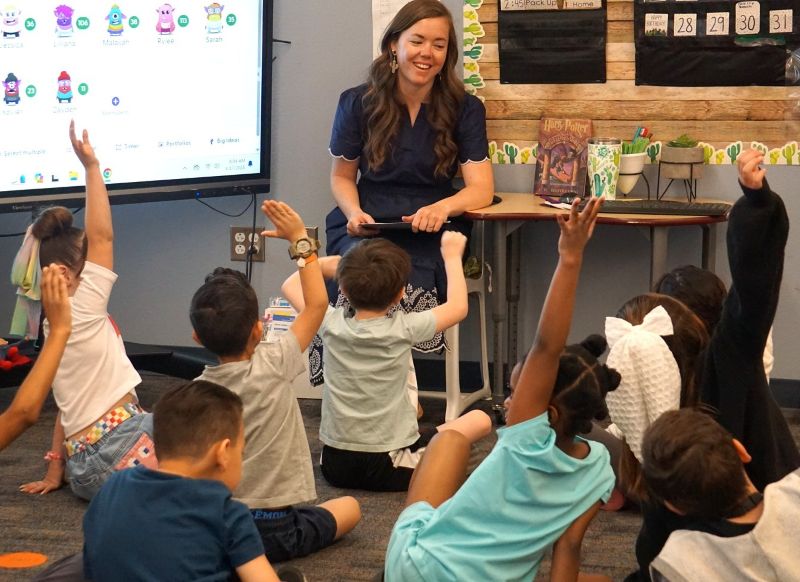
Second graders put their new skills to practice after a “read aloud” lesson. Photo Credit: Hanna Negusie, Project ECHO, April 2025.
Key Takeaways:
Educators, including Landry, take on literacy gaps in the classroom as a collective, easing the challenge of developing student-specific interventions. The collective solution approach of the SLC ECHO has helped educators improve student reading outcomes rapidly in schools and classrooms across New Mexico.
“The presenters offer practical takeaways that can be immediately applied in the classroom. I also appreciate that the regular check-ins hold us accountable for implementing the materials,” adds Landry.
Launched in 2023, 205 educators from 30 school districts across New Mexico have participated in the SLC ECHO Program – translating to an estimated 4,100 students benefitting from improved literacy instruction across New Mexico.
Conclusion:
Early results from educators participating in the Structured Literacy Classroom ECHO program show substantial gains in student reading proficiency, demonstrating the power of pairing the science of reading with ongoing implementation support.
Now, students can: systematically decode unfamiliar words; apply phonemic awareness to break apart and build words; and read and write with greater accuracy and fluency. Landry credits her effective interventions to the ongoing support she receives through the SLC ECHO community.
Deputy Superintendent of the Alamogordo School District Steven Starkovitch has seen the impact firsthand: “When Ms. Landry’s students came to her, they couldn’t write. They were struggling. And now, through this program, she has her students performing. I’m a big believer in the SLC process. My philosophy is when our teachers are learning more, our students are learning more.”
The Structured Literacy ECHO Program is a free program for New Mexico’s educators; sign up to receive information about upcoming sessions.
Featured Image: Alamogordo teacher Kim Landry interacts with her second-grade class. Photo Credit: Hanna Negusie, Project ECHO, April 2025.