
Background
Nearly two million Americans are currently incarcerated — a number that surpasses the population size of many small states — yet prison settings are often overlooked as sites for health education interventions. The New Mexico Peer Education Project and the Community Peer Education Project transform the experience of incarceration and reentry by integrating health education, leadership training, and mentorship into the lives of incarcerated people and returning citizens.
Launched in 2009, the New Mexico Peer Education Project, a partnership between Project ECHO and the New Mexico Corrections Department, is a collaborative effort to reduce hepatitis C infection rates in prison settings. Over time, the program’s peer-to-peer learning approach not only improved infectious disease prevention but also provided incarcerated people with a renewed sense of hope and purpose.
The success of the New Mexico Peer Education Project led to the development of a reentry-focused program: the Community Peer Education Project, which provides formerly incarcerated people with peer support as they navigate reentry.

Challenge
The New Mexico Peer Education Project is a pathway to leadership and community building for participants. By transforming the experience of incarceration into an opportunity for learning, peer educators gain real-world skills and begin to imagine new possibilities.
“Peer education is impactful because it is a simple way to understand our health and digest complex information. It breaks down learning into five questions: How do you get it hepatitis C? How do you know you have it? What can happen if you don’t get it treated or cured? Can it be treated or cured? And how can you prevent from giving it to others?” says Carissa Holloway, senior program manager for the Project ECHO’s Justice and Behavioral Health Team. “If we’re able to answer those questions about hepatitis C, it dares us to think: What else outside of health can we answer using those five questions? It stirs curiosity.”
Peer educators become experts in their own health and promote healthy practices in prison communities, which serves as a starting point for preparing for life after incarceration. But, the transition into society comes with its challenges.
Returning citizens—or people who re-enter society after incarceration—are often expected to build a new life from scratch, in a rapidly changing society — without support. Finding a job, securing housing, and reaching basic life milestones can be uphill battles, especially for people who were incarcerated for long periods of time. Because of the roadblocks experienced during reentry, some returning citizens become re-incarcerated within three years of their release — a term called recidivism. In New Mexico, the recidivism rate recently reached 40%.
The Community Peer Education Project provides returning citizens with a network of support during the reentry process so that they can successfully transition to new lives. Returning citizens are paired with peers who offer mentorship and ongoing guidance, and the access to resources has been life-changing for CPEP participants.
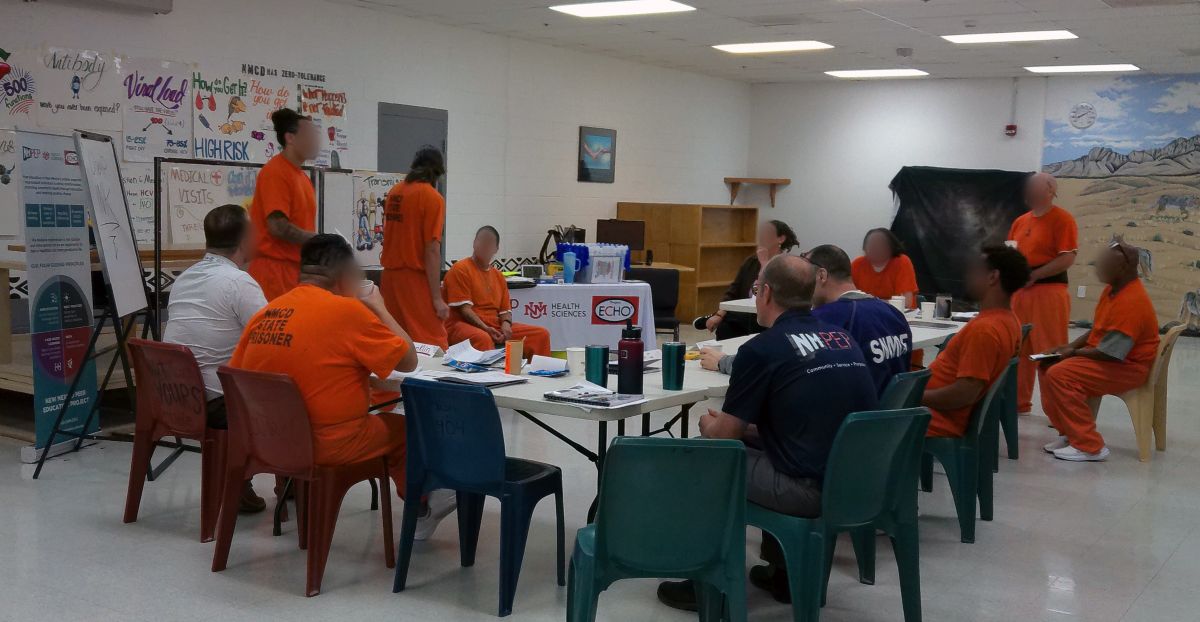
Peer educators at the Southern Level 2 Correctional Facility in Las Cruces, NM, present hepatitis C prevention best practices. Photo Credit: Bertha Rubio, Project ECHO, May 2025.
Actions
Program specialists with the Community Peer Education Project help participants navigate reentry by connecting them to services and resources.
When one participant was having a difficult time securing housing, their program specialist leveraged the CPEP network to find a point of contact to correct the problem and get the participant into housing before the holidays.
Similarly, Program Specialist Kira Vaughns connected a participant to counseling services and witnessed how she “made real life changes for herself.” The participant applied what she learned in counseling to her relationships, and improved her work and family life. Peer educators and the CPEP network help returning citizens move past roadblocks instead of falling through the cracks.
Positive Outcomes
Launched in 2020, CPEP has referred more than 1,500 participants for employment and more than 1,200 people have received housing referrals.
Returning citizens involved in CPEP experienced a 50% increase in housing stability and two-thirds found employment within three months of release, according to a 2023* study. Through peer support and resources, returning citizens are able to find a new path forward.
Key Takeaways

Highlights from Zoom interviews with Kira Vaughns (top left), Carissa Holloway (top right), Bertha Rubio (bottom left), and Ambrosia Garcia-Reed (bottom right). Photo Credit: Hanna Negusie, Project ECHO, May 2026.
The impact of peer education extends beyond the participants. Peer educators continue developing new skills and giving back to their community through CPEP. Ambrosia Garcia-Reed, former peer educator and current administrator for the New Mexico Office of Peer Recovery and Engagement, applied the knowledge from peer education to mend a broken relationship with her mother. By understanding her mother’s health condition, Garcia-Reed was able to renew their connection, which lasted until her mother passed away.
Peer educators, including Garcia-Reed, share a unique experience. Through CPEP, they are able to reflect with a network of peers and share what they’ve learned with others.
“We’re here for the participants primarily, but we’re also here for each other,” says Garcia-Reed. “This position is not just about work. It’s about really being able to give a hand up to someone. You’ve gone through these horrible experiences. You’ve learned from them. You’ve built a life from them. Now, you turn around and help somebody else do the same.”
Conclusion
The New Mexico Peer Education Project and the Community Peer Education Project are improving community health and well-being through mentorship, shared learning and community building. Peer education touches the lives of all involved in the network.
“Peer education is built on trust, shared experiences, and real-world understandings. It is impactful because these people are not only learning, but they become leaders, mentors, and share what they’ve learned within their communities — and once they are released, with their families and loved ones,” says Bertha Rubio, program specialist.
For more information on the New Mexico Peer Education Project, visit their iECHO page. For information on the New Mexico Community Peer Education Project, or with general questions, email the program team.
*The study was funded by the Centers for Medicare and Medicaid Services.
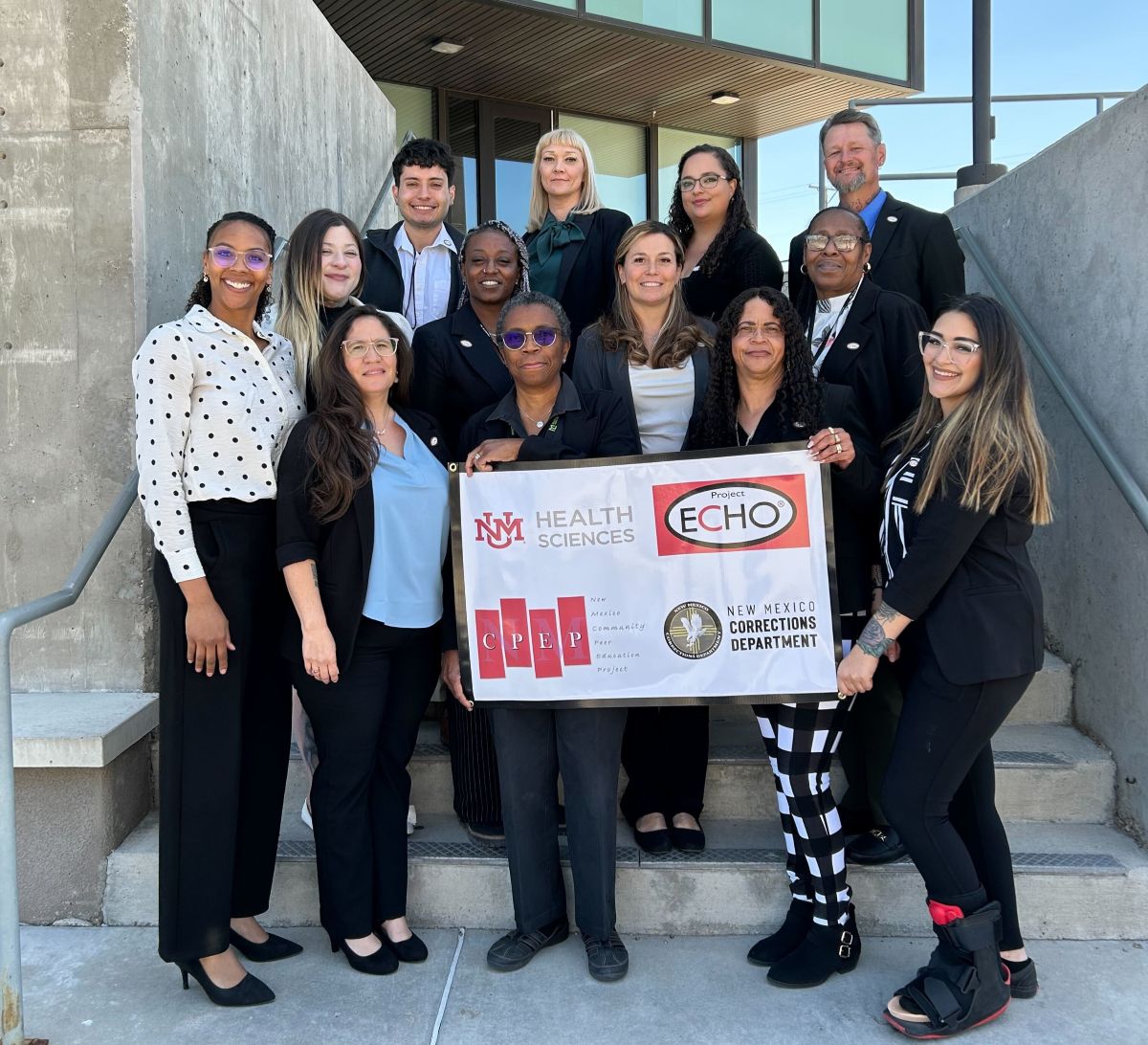
Featured Image: The New Mexico Community Peer Education Project team stands outside of the Project ECHO building at The University of New Mexico Health Sciences Center. Photo Credit: The CPEP Team, March 2026.